
English 
No.36, Fada Road, Taicang, Jiangsu
Views: 0 Author: Site Editor Publish Time: 2026-05-23 Origin: Site


Upgrading or repairing an RV poptop roof mechanism requires more than just measuring a fiberglass shell. You must accurately calculate dynamic forces to prevent catastrophic failure. Misjudging load capacities often leads to stripped gears, burnt-out actuators, or a roof refusing to close flush. Many owners and builders mistakenly conflate static structural limits with active lift system capacities. Evaluating the correct lifting mechanism requires a deep understanding of the exact physical load, leverage geometry, and shifting environmental variables. You cannot rely on baseline shell estimates alone when outfitting your rig. This guide breaks down exactly how to calculate true roof weight and uncovers hidden environmental loads. You will explore specific engineering differences between hinged setups and vertical lifting designs. Finally, we establish strict decision-stage criteria to help you select a reliable lift system without over-engineering your build.
Separate Dynamic from Static: "Roof Up" (lifting capacity) and "Roof Down" (static load limits) require entirely different weight calculations.
Account for Hidden Variables: Wet canvas, heavy snow loads, and torsion spring tension drastically alter the real-world lifting force required.
Apply a Safety Multiplier: Standard engineering practice dictates a 1.5x safety factor for standard poptops and 2.0x for heavy-use or expedition builds.
Beware the Closed-Length Constraint: The most common buying mistake is selecting actuators that mathematically support the weight but physically prevent the roof from fully closing.
Manufacturers often list a maximum capacity specification inside your camper manual. Owners frequently misinterpret this single number. When a manual states a "150 lbs maximum capacity," it rarely describes the physical breaking point of the fiberglass shell. Instead, it describes the accessory weight allowance. This number indicates exactly how much extra gear your factory lift motors or gas struts can raise safely. Pushing past this allowance strains the mechanics long before it compromises the structural framing.
You must separate your calculations into two distinct physical states. We classify these states as "Roof Down" and "Roof Up" scenarios. Each state relies on entirely different support architectures.
Roof Down (Static Load): The RV wall framing and roof joists support the load. Vehicles handle massive static weight in this position. Thick snow accumulation or an adult walking across structural joists rarely causes failure here.
Roof Up (Dynamic Load): The mechanical lifting system bears the entire burden. Actuators, gas struts, or manual crank wires support everything. This active state is highly sensitive to minor weight additions. Exceeding dynamic limits causes motors to overheat or lifting wires to snap.
Manual lift setups introduce a unique sensory deception. Older or custom campers often hide torsion springs inside the lifting arms. When you pull the roof down, these springs coil tightly. They store significant kinetic energy during descent. When you unlatch the system to open the camper, these springs release their stored energy. This upward thrust masks the true physical weight of the roof. Owners feel an artificially light shell. Because it feels light, they frequently under-spec replacement struts or linear actuators. You must calculate mechanical load based on actual scale weight, entirely ignoring human physical perception.
Designing a reliable RV Poptop Roof requires precise weight baselines. You cannot guess the shell weight. Custom DIY camper roofs built from foam and wood usually weigh between 120 and 130 lbs. Factory roofs on older full-size truck campers easily exceed 200 lbs due to thick fiberglass and internal bracing. You must establish this baseline before adding external accessories.
Modern camping demands extensive roof-mounted gear. Every accessory changes the required lifting force. Rigid solar panels add substantial weight compared to flexible alternatives. Awning hardware shifts the center of gravity to one side. Recreational gear adds massive, irregular burdens.
Accessory / Load Type | Estimated Weight Range | Impact on Lift Dynamics |
|---|---|---|
Solar Arrays (Rigid) | 30 - 50 lbs | Adds permanent, evenly distributed baseline weight. |
Awning Hardware | 20 - 30 lbs | Creates an off-center load, requiring stronger struts on one side. |
Recreation Gear (Kayaks, Boards) | 100 - 195 lbs | Massive variable load. Frequently exceeds factory dynamic lift ratings. |
Winter Insulation Layers | 10 - 20 lbs | Internal weight addition. Often overlooked during seasonal trip planning. |
Environmental variables introduce hidden loads you cannot measure in a garage. Canvas tent fabric acts like a sponge during heavy rain storms. Soaked tent material significantly increases the baseline lift weight. A roof opening easily in dry conditions might stall completely after a torrential downpour. You must design your lifting mechanics to handle this saturated weight.
Snow presents an entirely different challenge. Wet snow load forces you to reconsider your "Roof Down" static limits. Heavy, wet snow accumulation crushes weak roof membranes. You must clear heavy snow before attempting to lift the top. No standard actuator system safely lifts an extra 300 lbs of accumulated ice and snow without risking catastrophic mechanical binding.
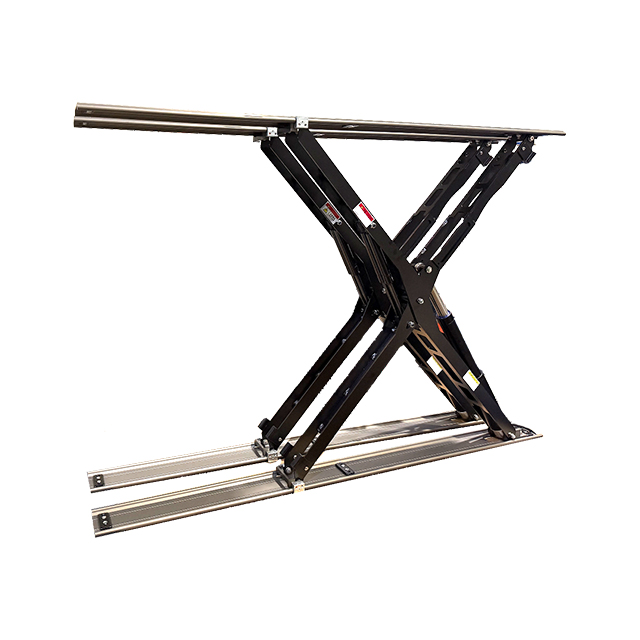
Lift systems primarily fall into two distinct engineering categories. You will encounter vertical lifting platforms and hinged lid mechanisms. Each geometry requires completely different mathematical approaches for calculating required thrust.
Integrating a Vertical Lifting Mechanism for RVs demands even load distribution across all lifting points. Vertical systems push the entire roof straight up simultaneously. You calculate the required thrust using a simple load-sharing equation. You take the total loaded roof weight, multiply it by an engineering safety factor of 1.5, and divide the result by the number of actuators. If your loaded roof weighs 200 lbs, the safe target is 300 lbs. Four actuators would each need to support 75 lbs. Vertical mechanisms absolutely require perfect synchronization. Uneven lifting causes binding, which warps the structural rails.
Hinged roof mechanics rely heavily on lever physics. A hinged top pivots from a fixed point at the rear or front of the camper. The lifting force required changes drastically depending on the angle of the roof. Force requirements hit their peak at the dead-point. The dead-point occurs when the roof is fully closed at roughly zero degrees. Actuators lie almost flat in this state. They possess terrible leverage geometry. Pushing a 150-lb hinged roof from a flat position might require 400 lbs of linear actuator thrust.
Mounting distance solves this dead-point leverage problem. You must mount the actuator base as far away from the hinge as physically possible. Standard engineering guidelines suggest aiming for 85% of the total roof width. Pushing near the opening lip requires significantly less thrust than pushing near the hinge. Shortening this distance increases motor strain exponentially.
Regardless of your mechanism style, you must apply a strict engineering safety factor. We mandate a 1.5x multiplier for all baseline lift calculations. This overhead absorbs manufacturing tolerances in cheap actuators. It overcomes wind resistance during an active lift. Most importantly, it handles uneven payload distributions when you load kayaks slightly off-center.
Selecting the wrong lifting hardware turns a weekend camping trip into a maintenance nightmare. Many builders obsess over lift capacity while ignoring critical physical dimensions and environmental ratings. You must evaluate mechanisms against strict real-world constraints to guarantee long-term reliability.
Below are the most critical implementation risks you must navigate during the selection phase:
The Closed-Length Constraint: This physical interference represents the most common design failure. The actuator stroke length must mathematically equal your desired lift height. However, the retracted actuator body must physically fit inside your cabin. It must slide between the ceiling and the mounting base when fully compressed. Failing to calculate this closed-length dimension prevents the roof from latching shut.
Synchronization Imperatives: Using independent linear actuators without a central synchronization controller guarantees rapid mechanical failure. Minor speed variances always exist between motors due to standard manufacturing tolerances. One side will invariably lift slightly faster than the other. This speed difference causes "racking" or twisting. Racking binds the sliding mechanism, burns out the slower motor, and permanently bends the lifting frame.
Hardware Vulnerabilities in Manual Systems: Pushing a manual hand-crank system beyond its recommended dynamic capacity creates hidden damage. The soft metal gears inside the winch box wear down rapidly under extreme tension. Wire ropes fray and snap without warning. Overloaded manual systems require frequent gear inspections to prevent a sudden roof collapse.
Ingress Protection (IP) Ratings: Standard IP54 actuators fail quickly if exposed to outdoor elements. IP54 components only survive inside fully sealed cabins. Exterior-mounted gas struts or motorized arms demand a strict IP66 rating. IP66 components survive high-pressure driving rain, highway grit, and heavy condensation.
Before purchasing replacement parts or finalizing a custom build, you must audit your existing architecture. Look closely at how the current roof interfaces with the camper frame. Determine if you have an aluminum track system or a simple fixed strut mount. Track systems allow the mounting geometry to slide, while fixed mounts limit your actuator length options.
You must accurately assess whether your roof is structurally walkable. Builders use the "Ladder Rule" as a quick visual indicator. If the factory installed a rear access ladder, they likely reinforced the roof joists for walking. If no ladder exists, you must treat the surface as a fragile membrane. Never walk directly on an unsupported membrane. You must lay down OSB board or thick plywood to distribute your weight across multiple internal joists.
When evaluating vendor specifications, demand complete transparency. Look for clear linear force ratings published in pounds or Newtons. Verify the exact stroke lengths. Check the documented duty cycles to ensure the motors will not overheat during repeated testing. You should actively avoid vendors who refuse to publish exact closed-length dimensions. Without closed-length data, you cannot verify physical cabin fitment.
Finally, you must decide between manual gas struts and powered linear actuators. Gas struts offer incredible reliability for lightweight, consistent loads. They require zero electricity. However, you must meticulously calculate the difference between the holding force required when the roof is up and the compression force required to pull it down. Over-sizing a gas strut makes the roof impossible to close manually.
Powered linear actuators excel at lifting heavy, variable accessory loads. They easily push thick solar arrays and heavy roof racks. They do not fight you when lowering the roof. However, powered systems introduce electrical dependency. You must install strict electrical redundancy. Always verify your chosen linear actuators feature a manual override capability. A dead house battery should never trap you with an open roof during a storm.
Sizing a poptop mechanism demands calculating peak load at the worst leverage point, ignoring baseline fiberglass weight.
Applying a strict 1.5x safety multiplier absorbs wind resistance, wet canvas weight, and off-center accessory loads.
Always measure the closed-length clearance inside your cabin to ensure your chosen actuators allow the roof to latch fully.
Inventory every planned roof accessory, including rigid solar panels and awnings, before purchasing struts or lift motors.
A: Look for the "Ladder Rule." If the manufacturer installed a factory ladder, the roof joists are likely rated for walking. If not, treat it as a non-walkable roof to avoid membrane collapse. Always distribute your weight using thick plywood across the joists if maintenance is strictly required.
A: Repeatedly lifting weight beyond the manufacturer's dynamic rating causes the soft metal gears in crank mechanisms to wear down and strip. This often happens after adding heavy solar panels. Once the gear teeth deform, the mechanism loses its ability to hold tension, causing dangerous slippage.
A: Yes, but there's a trade-off. While stronger struts make the roof easier to open, they make pulling the roof down exponentially more difficult and put excessive strain on the roof latches when closed. You must carefully balance lifting assistance with manual compression capability.


