


No.36, Fada Road, Taicang, Jiangsu
Views: 0 Author: Site Editor Publish Time: 2026-06-30 Origin: Site


Designing a reliable poptop requires precision engineering and careful planning. You cannot simply bolt on generic hardware and expect flawless operation. An undersized lifting system inevitably leads to structural failure, while an oversized one adds unnecessary weight and complicates installation. For upfitters and manufacturers, the stakes remain incredibly high. Mismatched components cause poor user experiences and trigger frustrating warranty claims. They can also compromise weather seals and introduce serious safety hazards on the road. In this guide, we will explore exactly how to evaluate load capacities and define your specific height requirements. You will learn how to analyze different mechanism categories effectively for your custom builds. Ultimately, you will discover how to select the perfect system based on evidence-backed specifications rather than risky guesswork.
Total roof weight must account for both static loads (the roof itself) and dynamic payloads (solar panels, roof racks, snow loads).
Opening height dictates the geometric requirements of the lift system; inclined mechanisms and vertical scissor lifts solve different spatial constraints.
Selecting an RV Poptop Roof requires aligning mechanism lifting force (measured in Newtons) with the specific pivot point and weight distribution of the roof build.
Proprietary hardware, such as the Dongtai Self-Developed Inclined Lifting Mechanism-Tzqt4978, offers standardized performance for specific upfitter profiles, reducing custom engineering risks.
Long-term reliability depends heavily on precise installation tolerances and matching the mechanism to real-world operational environments.
Engineers often face a difficult balancing act when designing camper lifting systems. Under-speccing the lifting force creates immediate operational problems. Weak gas struts will fail prematurely under heavy loads, and electric motors will quickly burn out from excessive strain. Conversely, over-speccing creates entirely different dangers. Installing heavily pressurized struts on a lightweight roof generates massive return tension. You will struggle to pull the roof down, and the upward pressure can easily warp fiberglass frames or snap locking latches over time.
A successful RV Poptop Roof integration must perform flawlessly across three specific areas. First, it must lift smoothly without requiring intense physical exertion. Second, it must hold securely under severe environmental stress. High winds and heavy rain try to push the roof down or shear it sideways. Finally, the assembly must close flush against the vehicle body. It should do this without straining the canvas material or over-compressing the sealing gaskets.
You must differentiate between the physics of full-length vertical lifts and wedge-style inclined poptops. Vertical lifts push the entire roof assembly straight up. They require uniform lifting force across four distinct points. Wedge-style roofs use a rear pivot point. This rear hinge fundamentally alters the force requirements. A wedge design acts like a lever. The closer you push near the hinge, the harder the system must work. Understanding this lever principle helps you position lifting hardware optimally along the vehicle frame.
Before buying hardware, you must calculate the exact baseline weight of your roof shell. This represents the static load. You must weigh the raw fiberglass, aluminum, or composite materials. Add the interior headliner fabrics, insulation foam, and integrated lighting fixtures. This fixed number rarely changes, but it serves as the foundation for your hardware selection.
Most structural failures occur because builders ignore dynamic loads. You must factor in aftermarket weight additions. Consider the following additions carefully:
Solar arrays: Include the panels, mounting brackets, and heavy wiring harnesses.
Storage gear: Account for roof racks, cargo boxes, and mounted gear like kayaks or heavy traction boards.
Environmental variations: Remember rainwater pooling on flat surfaces. Winter snow loads add significant crushing weight overnight.
The placement of weight fundamentally changes the required lifting force of your chosen RV Poptop Roof Mechanism. A 30-kilogram air conditioning unit mounted at the rear hinge requires very little lifting effort. Move that same unit to the front edge of a wedge roof, and the mechanical leverage multiplies the perceived weight drastically. You must calculate the center of gravity for your fully loaded roof before selecting strut pressures.
Load Category | Component Examples | Weight Variability | Impact on Mechanism Force |
|---|---|---|---|
Static Load | Fiberglass shell, interior insulation, built-in LED lights | Fixed (Constant) | Establishes the absolute baseline Newton rating. |
Fixed Dynamic Load | Solar panels, roof racks, awnings | Semi-Fixed (Rarely changes) | Shifts the center of gravity; requires recalculation of lift points. |
Variable Dynamic Load | Luggage, kayaks, snow, pooling rainwater | Highly Variable | Requires building a 15-20% safety margin into the lifting force. |
You need to establish a target interior standing room based on the base vehicle dimensions. Measure from the floor to the interior ceiling limit. A tall cargo van might only need a slight poptop angle for full standing clearance. A low-profile minivan requires maximum extension. You must define these clearance goals early in the design phase.
Builders must balance maximum opening height against the structural integrity of the tent fabric. If the roof opens too high, it stretches the canvas beyond its design limits. This damages stitching and ruins waterproof seams. Conversely, excessive height increases vulnerability to crosswinds. A taller profile catches more wind, putting immense lateral shear stress on the lifting hinges. You want the canvas taut enough to shed water, but not so tight it acts like a drum.
You have to match the extended length of the lifting mechanism to your desired apex height. The stroke length refers to the distance the internal rod travels from fully closed to fully open. You should never max out the hardware travel limits. The mechanism must hit full extension right as the canvas reaches optimal tautness. If the hardware maxes out before the canvas tightens, the fabric will sag.
For wedge roofs, you must calculate the optimal angle carefully. The angle dictates the usable sleeping space inside the berth. A steeper angle provides excellent headroom but might restrict foot-room near the rear hinge. You need to map out the sleeping geometry to ensure adults can comfortably turn over without hitting the fiberglass shell.
Gas struts remain the best option for lightweight, straightforward builds. They boast low initial costs and easy installation. However, pneumatic systems are highly sensitive to temperature fluctuations. A strut performing perfectly in summer might fail to lift the roof in freezing winter conditions. They also struggle to adapt if you suddenly add heavy solar panels later.
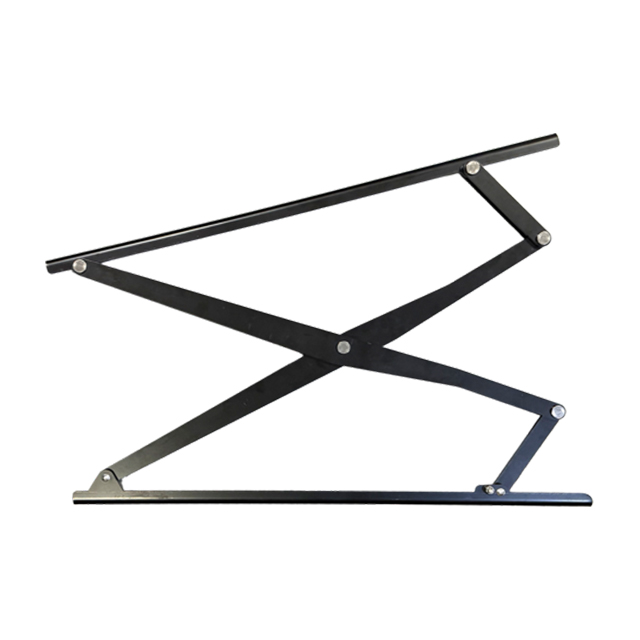
Scissor lifts provide incredibly stable, uniform vertical lifting. They are ideal for heavy, full-length poptops found on larger expedition vehicles. Despite their stability, they require significant lateral installation space. You must align them perfectly during installation. Even slight misalignment causes severe binding when raising or lowering the roof.
Engineers design these specifically for wedge-style roofs. They provide guided, stable arcs of motion rather than simple raw pushing force. For instance, integrating the Dongtai Self-Developed Inclined Lifting Mechanism-Tzqt4978 makes projects highly predictable. It offers engineered load tolerances and specific inclination angles right out of the box. Using specialized kits eliminates the dangerous trial-and-error process of matching generic gas struts to custom roof molds.
Motorized linear actuators offer convenient push-button operation. They handle incredibly heavy payloads effortlessly. However, introducing electrical components increases system complexity. You must route wiring securely and install waterproof relays. More importantly, motorized systems absolutely require manual override redundancies. If the vehicle battery dies in the wilderness, you must still be able to close the roof.
Mechanism Type | Ideal Roof Style | Load Capacity | Primary Advantage | Primary Limitation |
|---|---|---|---|---|
Gas Strut | Lightweight Wedge | Low to Medium | Simple installation, lightweight | Temperature sensitive, fixed lifting force |
Scissor Lift | Full-Length Vertical | High | Exceptional lateral stability | Requires precise alignment, bulky |
Specialized Inclined | Heavy Duty Wedge | Medium to High | Engineered geometry, predictable arcs | Specific to wedge designs only |
Motorized Actuator | Oversized / Expedition | Very High | Effortless push-button lifting | Electrical complexity, heavy |
You must acknowledge the harsh reality of chassis flex and roof warping. When you drive an RV off-road, the vehicle frame twists over uneven terrain. The lifting mechanisms must possess slight lateral play. If you bolt everything down rigidly without tolerances, the system will bind. A binding mechanism refuses to close properly and can shatter internal bearings during deployment on angled ground.
Builders frequently overlook the routing pathways for the fabric. As the roof descends, the canvas folds inward. You must ensure the lifting mechanism does not pinch or tear the tent during closure. Some builders use internal bungee cords to pull the canvas safely away from scissor joints and actuators.
The compressed height of your hardware dictates your weather seal options. When fully closed, the mechanism takes up physical space between the roof and the chassis. This gap determines whether you use thick rubber D-seals or flat foam gaskets. If the mechanism prevents the roof from locking down tightly, water ingress becomes inevitable at highway speeds. You must calculate the exact compressed dimensions before molding the roof lip.
Every mechanical component experiences fatigue. Gas springs eventually lose their nitrogen charge. Electric actuators suffer gear wear. You should evaluate systems based on the availability of replacement parts. A highly customized, welded-in system creates a nightmare for future servicing. Always design the interior trim so you can easily unbolt and replace failing struts or motors without tearing apart the entire headliner.
Cap the Weight: You must finalize your roof design first. Lock in your choices for solar panels, insulation, and roof racks. Establish your absolute maximum accessory payload before you ever look at a mechanism catalog.
Define the Geometry: Choose your style based on the base vehicle type and user requirements. Decide firmly between a full vertical lift or an inclined wedge configuration. This choice immediately narrows your hardware options.
Audit the Specs: Gather the data sheets. Cross-reference your required Newton lifting force and target stroke length against manufacturer-verified testing data. Do not rely on estimates.
Assess Vendor Reliability: Always prioritize mechanisms backed by documented cycle testing. Look for clear warranty terms and responsive engineering support. Avoid unbranded, generic hardware found on discount marketplaces; they rarely survive rigorous outdoor use.
Matching a lifting mechanism to an RV roof demands a thorough understanding of physics, weight distribution, and geometric constraints. You cannot guess the required lifting force or simply estimate dynamic loads. Accurate load calculations and defined target heights directly dictate which hardware will survive long-term use. Remember, over-engineering slightly is generally preferable to under-engineering, provided your locking latches can comfortably handle the return tension. We highly encourage upfitters and custom builders to consult technical spec sheets rigorously. Always request detailed engineering drawings from mechanism manufacturers before you finalize your expensive roof mold designs.
A: Adding solar panels increases your dynamic load and shifts the center of gravity. If your current mechanism barely lifts the empty roof, adding panels will cause sagging. You will likely need to recalculate the total load and upgrade your gas struts or actuators to prevent structural failure and ensure smooth operation.
A: You must use the lever principle. Multiply the total roof weight by the distance from the rear hinge to the roof's center of gravity. Divide that number by the distance from the rear hinge to your mechanism mounting point. Finally, convert kilograms to Newtons by multiplying by 9.81.
A: Yes, but retrofitting requires significant structural reinforcement. Motorized linear actuators exert intense localized force compared to gas struts. You must ensure you have adequate space for the bulkier motors. You also need to route heavy-gauge electrical wiring safely and install weather-sealed control relays inside the cabin.
A: High-quality gas struts typically last five to seven years under normal conditions. Frequent exposure to extreme temperatures or heavy daily cycling accelerates seal degradation. Motorized actuators can last over a decade if kept clean and adequately lubricated. Regular maintenance greatly extends the lifespan of any lifting hardware.


